Nirji Semicon logo

Partners & Institutions

Why Engineering Colleges Should Partner with India's Semiconductor Industry Now

India's new semiconductor plants need thousands of job-ready graduates, and engineering colleges produce the raw talent. Here's why universities and training partners should partner with the semiconductor industry now, and how a partnership with Nirji Semicon works.

Vani Upadhyay · · 5 min read

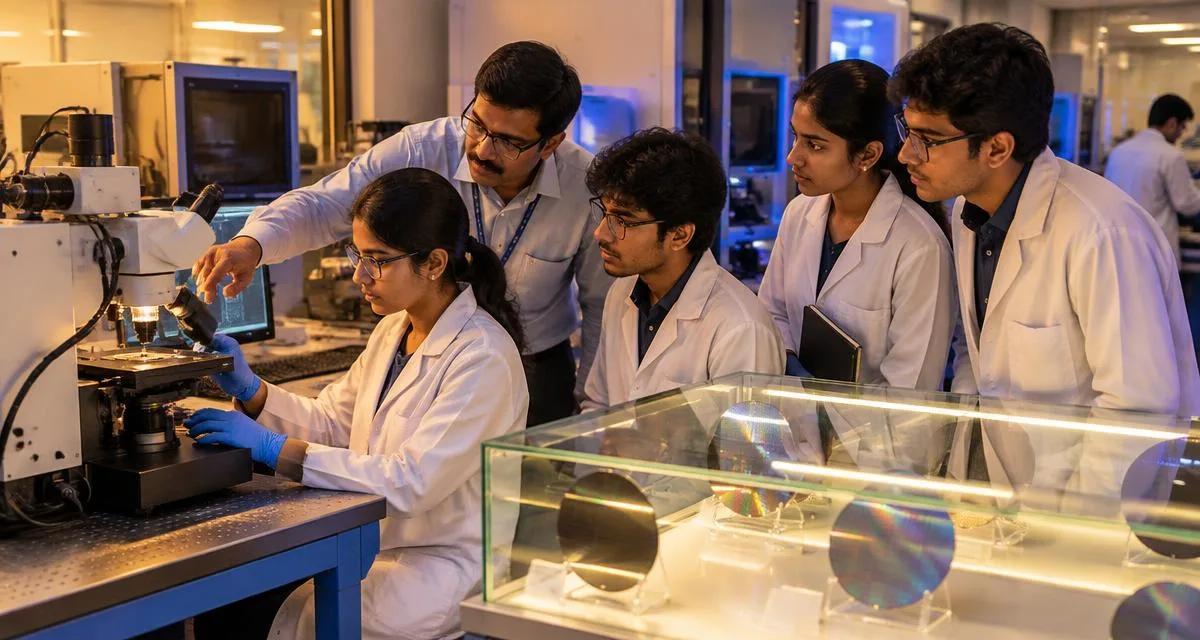
Engineering students and faculty in a semiconductor training lab in India

Every year, India's universities and engineering colleges produce a large pool of graduates in electronics and communication, electrical, instrumentation, mechanical, chemical and physics disciplines. At the same time, India's semiconductor plants are moving into production and need operators, technicians and engineers who are ready for a live line.

On paper, supply meets demand. In practice, there is a gap between what graduates learn and what a semiconductor plant needs on day one. Many capable electronics graduates still move into roles unrelated to their discipline, while semiconductor employers struggle to find people who can work in a cleanroom and run production equipment.

Institutions that close this gap will shape the next generation of India's semiconductor workforce. This article explains why it matters for universities and training partners, and how a partnership with Nirji Semicon works.

Why this matters for institutions now

India's semiconductor build-out has moved from announcements to factories. Assembly, test and packaging plants are hiring, and more fabs, packaging units and design centres are coming. For institutions, that creates three opportunities:

  • Better career outcomes for graduates. Semiconductor roles offer long-term careers in a strategic, high-technology industry.
  • Stronger industry linkage. Programmes built with employers keep curriculum current and relevant.
  • A distinctive reputation. Institutions known for producing semiconductor-ready graduates stand out to students, parents and employers.

The gap between the classroom and the cleanroom

Engineering programmes teach strong fundamentals in devices, circuits and physics. What most graduates have not experienced is the working reality of a semiconductor plant:

  • cleanroom protocol and contamination control
  • ESD discipline and safety
  • operating and maintaining production equipment
  • statistical process control and quality documentation
  • working to SOPs on a shift schedule

On the design side, employers look for fluency in industry tools and flows, and for project experience that resembles a real chip design cycle.

These are learnable skills, but they must be taught in an industry-defined way and assessed on demonstrated ability, not attendance.

How partnering with Nirji Semicon helps your institution

Nirji Semicon is a semiconductor workforce infrastructure company. We work with employers to define exactly what each role needs, then build and certify talent to that standard through a network of qualified delivery partners.

As a Nirji delivery partner, your institution gains:

ForWhat partnership brings
Students and graduatesIndustry-defined semiconductor pathways, practical skill-building, Nirji Ready certification and access to semiconductor employers
FacultyTrain-the-trainer certification, industry-aligned teaching material and exposure to current plant practice
The institutionIndustry-linked programmes and labs, stronger career outcomes, and a recognised place in India's semiconductor ecosystem
Your regionA visible semiconductor talent base that supports the state's efforts to attract investment

Who brings what

A strong partnership plays to each side's strengths.

Nirji Semicon bringsYour institution brings
Employer demand and role definitionsStudents and graduates in relevant disciplines
Workforce architecture and programme designFaculty and teaching capacity
Industry-defined modules, from foundation to role-specificClassrooms, labs and facilities
Independent assessment and Nirji Ready certificationDelivery to the programme standard
Connection to semiconductor employers and deploymentCandidate mobilisation and student support
Outcome tracking: trained, certified, deployed, retainedCommitment to continuous improvement

Where an institution needs equipment or lab set-up, Nirji Academy-in-a-Box packages the curriculum, labs, trainers, digital platform, assessment and reporting into a deployable academy that can run on your campus.

How the partnership works

  1. Expression of interest. Tell us about your institution, disciplines, capacity and facilities.
  2. Capability review. We assess trainers, labs and facilities against the Nirji delivery standard.
  3. Programme design and faculty onboarding. We agree the pathways to run, and certify your faculty to deliver them.
  4. Pilot cohort. A first cohort runs with independent Nirji assessment and employer connection.
  5. Scale. Proven partners expand to more pathways, cohorts and roles.

Partners are qualified on four measures: capability, quality, outcomes and compliance. Partnerships are increasingly linked to outcomes, so the focus stays on graduates who succeed on the job, not just on completion.

Who we are looking for

  • Universities and engineering colleges with electronics and communication, electrical, instrumentation, mechanical, chemical, physics or materials science departments
  • Polytechnics and ITIs preparing technicians and operators
  • Specialist training partners with semiconductor, electronics manufacturing or cleanroom expertise

Partner with Nirji Semicon

India's semiconductor workforce will be built in its classrooms and labs. Help us build it.

Frequently asked questions

How can engineering colleges partner with the semiconductor industry in India?

Colleges can join an industry-led delivery network such as Nirji Semicon's, which defines roles with employers, designs the programmes, certifies faculty, assesses graduates independently and connects certified candidates with semiconductor employers.

Which engineering branches are relevant to semiconductor careers?

Electronics and communication, electrical, instrumentation, mechanical, chemical, physics and materials science graduates all have pathways into semiconductor manufacturing and design, from process and equipment roles to quality, test and design roles.

Do we need a cleanroom to become a partner?

No. Many foundation and role modules can run in standard labs, and Nirji Academy-in-a-Box can provide the specialised curriculum, labs and simulators needed for hands-on training.

What does Nirji Ready certification mean for our graduates?

Nirji Ready certifies that a candidate has demonstrated readiness for a defined role at a defined level, across knowledge, practical ability, safety and other dimensions. It is not a course-completion certificate.

Is there a fee to become a delivery partner?

Partnership models depend on the pathways, facilities and scale involved. We agree the model with each institution during the capability review.

Share

Vani Upadhyay

Director, Strategic Initiatives

LinkedIn

Related Insights

Get new Insights by email

Occasional notes on India's semiconductor workforce. No spam; unsubscribe any time.

Bring semiconductor pathways to your campus.

Bring semiconductor pathways to your campus. Tell us about your institution and we will set up a capability conversation.